
Steel Connections Make Strong Impression

Anybody who appreciates modern architecture surely appreciates exposed steel connections, be they steel to steel or steel to another material. The material’s strength makes it ideal as a structural component in various ways. Welding, bolting, bending and other fastenings and manipulations give steel joints lots of character. This article focuses on these connections, looking at technical aspects but also the aesthetic richness they provide.
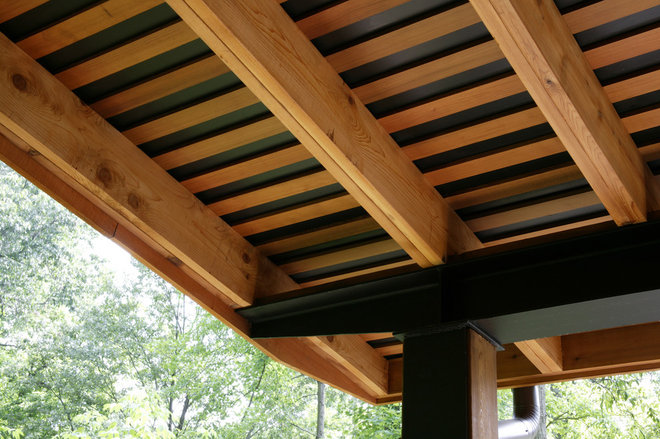
Here is a hybrid structure of wood roof joists resting on a perpendicular steel beam. (The next photo looks at the column.) The wood members are rectangular, but the steel beam uses an H- or I-section, such that the material is distributed where it’s needed: the flanges (top and bottom) and web (perpendicular piece connecting the flanges). This same economy of material extends to the cantilever, where the bottom flange disappears and the web tapers slightly.
The previous photo hints at the apparent wood-steel hybrid of the column, but this view of the base shows it more clearly. What is most likely happening is that the spaces between the flanges in the steel column (it is the same shape as the beam above, just turned 90 degrees) are filled with wood pieces. This gives the impression that the steel is a sleeve on two sides of a wood column; it also creates a strong balance between wood and steel in the overall design.

This project is inspired by the vernacular architecture of the Pacific Northwest in its use of salvaged timber and exposed steel. Here we see a wood beam hung from above; the steel rod and sleeve bolted to the beam do a lot to express the vernacular inspiration.
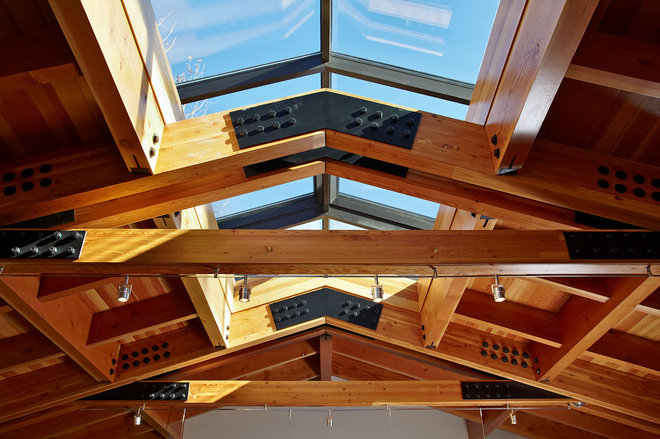
Here is some more hybrid construction: wood beams connected to one another with steel plates. A couple closeups follow.
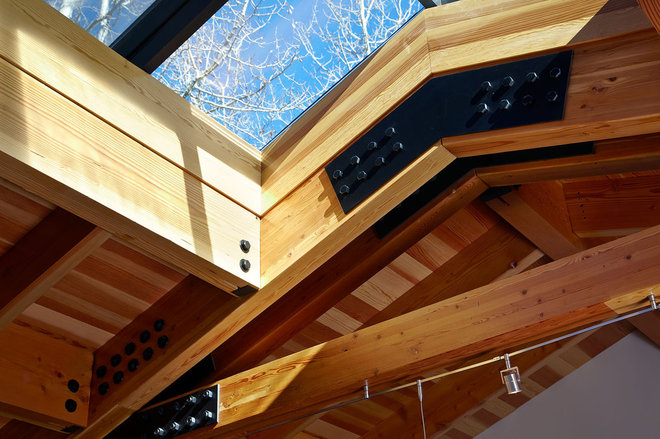
The contrast between the natural wood and the black steel is easily the most striking aspect of this ceiling. Compare this design with the previous example, in which the bolts are metallic; the black finish of the bolts here makes the contrast even stronger.

The alternation between areas with steel plates and areas without is also a striking aspect of the design; the former are like punctuation marks on the beams.

Steel-to-steel connections are of a different character than those of steel to wood, but their appeal is still evident. In this house, steel I-beams land upon cross-shape columns (most likely made up of multiple steel shapes welded together). The simple way that the steel disappears into the concrete slab is the antithesis of the beam-column connection above; it’s a nonconnection, or at least one hidden from sight.

This gable-roof space features white-painted steel members that are tied together with rods for lateral stability. Compared to the one in the previous example, the members are smaller and more lightweight. This is because the building is a camp, not a full-fledged home, meaning there’s less insulation and other materials in the walls and roof, adding up to a lightweight construction overall. A close-up (next) reveals the individual pieces.

In this close-up we can see that the verticals between the windows and the members supporting the roof are made from steel pieces bolted together in an L shape. A plate bolted between the angles receives the tension rod.
Read full article <HERE>